
If you are thinking about your next job, career change, or even what skills you should be developing, it helps to look beyond who is hiring today.
The better question may be: Who is likely to be hiring five or ten years from now?

Orange County has one of the largest and most diverse employment markets in California. We are not dependent on one industry. Healthcare, technology, tourism, professional services, construction, financial services, manufacturing, aerospace, medical devices, and dozens of other sectors all have a meaningful presence here.
But they are not all growing at the same rate.
The California Employment Development Department currently publishes 2023-2033 long-term employment projections for Orange County, which the state identifies as the Anaheim-Santa Ana-Irvine Metropolitan Division. Those projections estimate how employment will change as a result of economic growth, demographic shifts, technology, and other factors.
More recent Orange County research looking through 2035 points in the same general direction, particularly when it comes to healthcare, tourism, technology, life sciences, aerospace, and other skilled industries.
For job seekers, there is an important lesson in all of this.
Do not just look for a job.
Look at where the jobs are going.
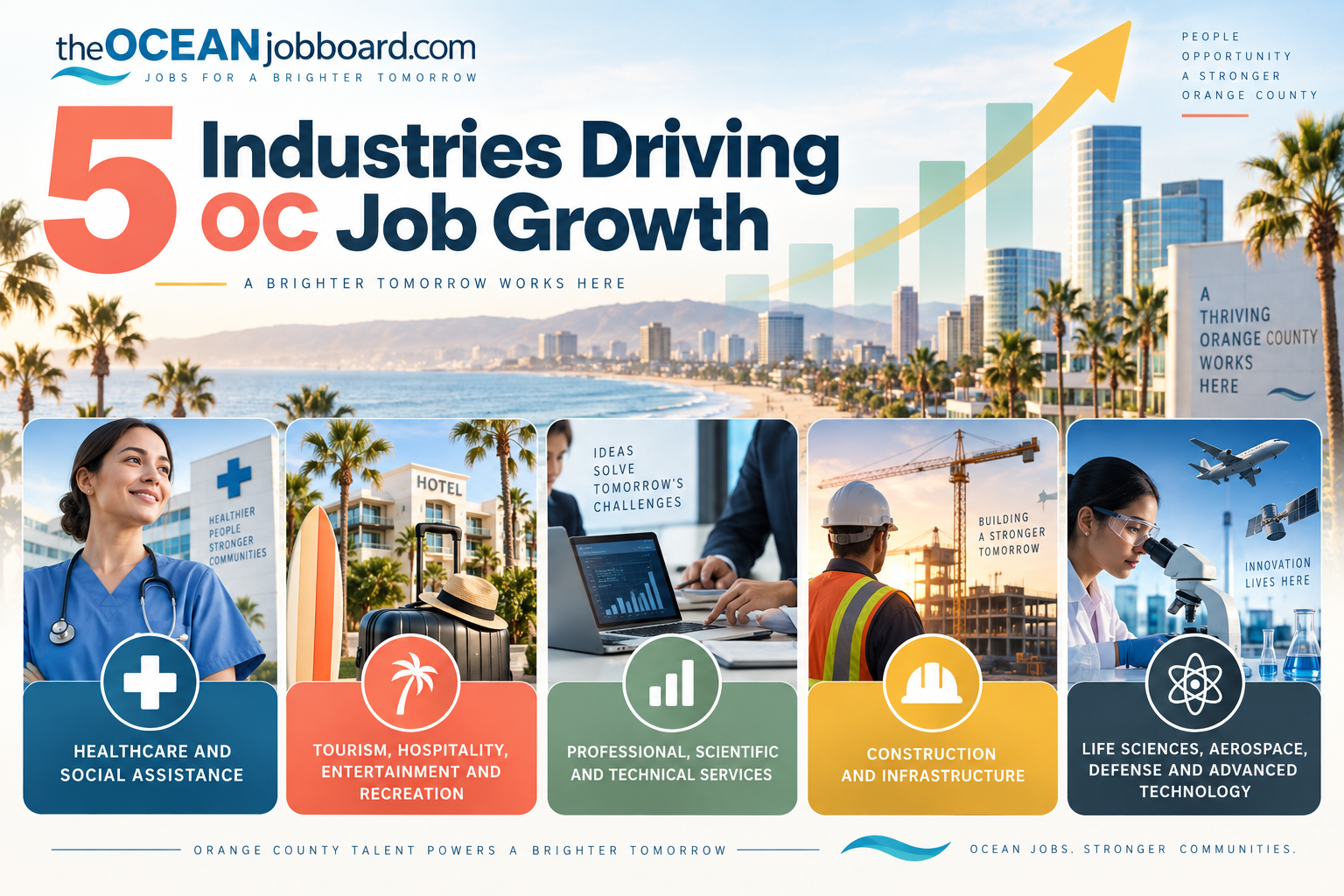
Here are five areas I would be paying particularly close attention to.
1. Healthcare and Social Assistance
If there is one industry where the numbers are difficult to ignore, it is healthcare.
The 2026 Orange County Economic Opportunity Report projects that healthcare alone will add approximately 49,771 jobs in Orange County by 2035. Even more interesting, 16,989 of those positions are expected to be middle-skill jobs, including medical assistants, licensed vocational nurses, technicians, and other roles that do not necessarily require a four-year degree.
We are already seeing that demand show up in the current job market.
During the 12 months ending in July 2026, Orange County’s private education and health services sector added approximately 13,600 jobs, including about 8,300 additional healthcare and social assistance jobs. That made it one of the clearest areas of employment growth in an otherwise mixed local labor market.
The long-term reasons are not difficult to understand.
Orange County is getting older. Healthcare utilization generally increases as populations age, and that creates demand far beyond doctors and nurses. Hospitals and medical groups also need people in administration, finance, IT, HR, scheduling, compliance, facilities, marketing, operations, patient services, and dozens of other functions.
That is something job seekers sometimes overlook.
You do not necessarily need a clinical background to build a career in healthcare.
A hospital is also a very large business.
So is a medical-device company.
So is a health system.
So is a network of physician practices.
For professionals in accounting, human resources, marketing, project management, cybersecurity, operations, sales, and technology, healthcare should probably be on your target-company list even if you have never considered yourself a “healthcare person.”
National projections reinforce the same trend. The U.S. Bureau of Labor Statistics expects private healthcare and social assistance to add more than 2.2 million jobs nationally between 2025 and 2035, accounting for approximately 37% of all projected U.S. job growth during the decade.
In Orange County, healthcare is not simply a large employer.
It is becoming one of the defining industries of the next decade.
2. Tourism, Hospitality, Entertainment and Recreation
People sometimes underestimate just how important tourism is to the Orange County economy.
Disneyland Resort, hotels, restaurants, beaches, convention business, entertainment venues, sports, outdoor recreation, and the broader visitor economy support an enormous employment ecosystem.
The Orange County Economic Opportunity Report projects approximately 29,736 additional tourism and outdoor recreation jobs by 2035.
We can already see momentum in the current labor market.
Orange County’s leisure and hospitality sector added approximately 7,200 jobs between July 2025 and July 2026, even while several other major sectors lost jobs.
That should get the attention of anyone who thinks of hospitality jobs as limited to hotels and restaurants.
The visitor economy needs:
- General managers
- Event professionals
- Sales teams
- Account managers
- Revenue managers
- Marketing professionals
- Digital marketers
- Operations managers
- HR professionals
- Finance teams
- IT specialists
- Security personnel
- Facilities professionals
- Chefs and food-service managers
- Guest-service teams
- Entertainment workers
- Skilled tradespeople
Orange County also has something that many markets do not: enormous existing tourism infrastructure combined with continuing investment.
That creates a multiplier effect.
A new attraction does not only employ people at the attraction. It creates demand for nearby restaurants, hotels, transportation, vendors, marketing agencies, contractors, event companies, suppliers, and professional services.
For someone beginning a career, hospitality can also provide something that is becoming increasingly valuable: experience working directly with people.
As AI and automation change more routine office tasks, communication, leadership, sales, hospitality, relationship-building, and customer-service skills may become even more important.
3. Professional, Scientific and Technical Services
Orange County has a huge professional workforce, particularly in Irvine, Costa Mesa, Newport Beach, Santa Ana, and surrounding business centers.
That includes consulting, engineering, software, law, accounting, scientific research, marketing, architecture, technical services, and a wide range of business-to-business companies.
Professional and business services remains one of Orange County’s largest employment sectors. In April 2026, the broader category employed roughly 316,000 people, making it the largest major private-sector grouping in the county at that point.
The short-term picture has been uneven. Professional and business services experienced some job losses during parts of 2025 and 2026.
That does not mean the long-term opportunity has disappeared.
It means the skills within the sector are changing.
Nationally, the Bureau of Labor Statistics projects professional, scientific and technical services to grow 8.6% from 2025 through 2035, adding roughly 927,000 jobs.
Some traditional administrative roles will undoubtedly be affected by AI and automation.
At the same time, demand should increase for people who can implement, manage, sell, secure, analyze, and apply new technologies.
That includes areas such as:
- Artificial intelligence
- Cybersecurity
- Data analytics
- Engineering
- Software development
- Business consulting
- AI implementation
- Compliance
- Research
- Project management
- Technical sales
- Digital strategy
This is where I think job seekers need to be careful about broad headlines such as “AI is taking jobs.”
Some jobs will absolutely change or disappear.
Others will be created.
The person who understands both an industry and how to use new technology within that industry may become considerably more valuable.
If you work in marketing, finance, operations, HR, engineering, technology, or another professional function, your career strategy should not simply be to compete against AI.
Learn how to work with it.
4. Construction, Infrastructure and the Clean Economy
Construction is already a major Orange County employer.
Recent regional research has estimated the sector at roughly 100,000 jobs, and EDD occupational projections show significant demand across construction management and skilled trades.
For example, EDD’s Orange County projections for construction managers showed employment growing from roughly 7,180 positions to 8,190, an increase of approximately 14.1%, with more than 6,400 total job openings expected during the projection period when growth and replacement needs are combined.
First-line supervisors of construction trades are projected to grow approximately 11.4%, while construction laborer employment was projected to increase about 16.1%.
But I would not think about this category as simply “building houses.”
Orange County will continue to need people to build, maintain, upgrade, retrofit, and operate:
- Commercial properties
- Healthcare facilities
- Housing
- Transportation infrastructure
- Hotels
- Entertainment projects
- Manufacturing facilities
- Utility systems
- Energy infrastructure
- Data and communications infrastructure
- Water systems
California’s energy and environmental policies also create another layer of opportunity.
Buildings will require retrofits.
Energy systems will change.
Electric infrastructure will expand.
Older properties will need upgrades.
That translates into demand for electricians, HVAC professionals, plumbers, project managers, engineers, estimators, construction managers, inspectors, designers, and skilled technicians.
And many of these careers offer another advantage.
They cannot easily be outsourced to another country.
Someone still has to show up and build the building.
5. Life Sciences, Aerospace, Defense and Advanced Technology
I am combining several related Orange County industry clusters here because they increasingly share the same talent pool.
Orange County has long-standing strengths in medical devices, healthcare technology, aerospace, electronics, engineering, semiconductor-related businesses, and advanced manufacturing.
Newer growth areas are layering AI, robotics, defense technology, biotechnology, and clean technology on top of that foundation.
The Orange County Economic Opportunity Report identifies aerospace and defense, the clean economy, life sciences and high-tech as key strategic growth sectors and projects approximately 8,000 additional jobs across these clusters by 2035.
Eight thousand may sound small compared with healthcare’s nearly 50,000 projected jobs.
But there is an important difference.
Many of these positions are highly skilled and highly compensated.
EDD data already show strong projected demand for engineering talent. Orange County industrial engineer employment, for example, was projected to rise approximately 15.8%, with a 2026 mean wage of almost $60 per hour.
The region also has a substantial life-sciences footprint. Recent Orange County economic research estimates roughly 20,000 jobs in medical supplies and equipment manufacturing, with the county maintaining particular strength in surgical and medical instruments.
That creates opportunities far beyond scientists and engineers.
These companies also need:
- Regulatory professionals
- Quality assurance
- Manufacturing specialists
- Supply-chain professionals
- Salespeople
- Product managers
- Project managers
- Finance
- Marketing
- Human resources
- IT
- Cybersecurity
- Operations leadership
One of the advantages Orange County has is that these industries overlap.
An engineer who has worked in medical devices may have skills valuable to aerospace.
A quality professional from aerospace may understand regulated manufacturing.
A cybersecurity professional can potentially move among healthcare, defense, finance, and technology.
That creates career mobility within the local economy.
Orange County’s Job Market Is Growing… But Not Everywhere
It is also important to be realistic about the current market.
The latest available California EDD data cover July 2026. Orange County’s unemployment rate was approximately 4.2%, and total nonfarm employment stood at roughly 1.69 million jobs.
Over the previous year, Orange County added about 10,300 payroll jobs, or roughly 0.6%.
But that growth was not evenly distributed.
Healthcare and private education grew substantially.
Leisure and hospitality grew.
Trade, transportation, and utilities posted gains.
At the same time, government, professional and business services, and several other sectors experienced declines.
That tells us something important.
There really is no such thing as “the job market.”
There are dozens of job markets happening at the same time.
A nurse and an administrative assistant may be experiencing completely different economies.
So might a software engineer and a hospitality manager.
Or a marketing director and an electrician.
That is why I encourage job seekers to look at industry trends instead of focusing only on job titles.
Follow the Growth, Not Just the Job Title
Suppose you are an accountant.
You could work for an accounting firm.
But you could also work for a hospital system, medical-device company, hotel group, construction company, aerospace company, software business, or manufacturer.
The same applies to marketing professionals, salespeople, HR professionals, administrative professionals, IT specialists, and executives.
Your occupation is only one part of your career.
Your industry may matter just as much.
If an industry is adding thousands of jobs, expanding facilities, attracting investment, and facing worker shortages, there will often be opportunities across the organization.
Not just in the obvious positions.
Replacement Jobs Matter Too
There is another number job seekers should understand.
Employment growth is not the same thing as job openings.
An industry may only grow by 5,000 net positions but need to hire tens of thousands of people because workers retire, change careers, relocate, or leave the workforce.
This is especially important in Orange County because our population is aging.
A job does not have to be newly created for you to get hired.
Someone may retire.
Someone may get promoted.
Someone may move to Texas.
Someone may leave to start a company.
That position still needs to be filled.
For example, EDD projected only about 1,340 net new jobs for Orange County maintenance and repair workers over its 2022-2032 projection window, but approximately 13,680 total openings when replacement needs are included.
That is a major distinction.
When researching careers, always look at both employment growth and total openings.
What I Would Do If I Were Job Hunting in Orange County
I would start by creating a list of 25 to 50 target employers.
Not simply 25 job postings.
Employers.
I would focus heavily on companies operating in industries likely to expand over the next decade.
Then I would follow those companies.
Connect with people who work there.
Attend events where their employees and executives participate.
Learn which departments are expanding.
Watch for new facilities, acquisitions, funding announcements, contracts, product launches, and leadership hires.
Those can all be early signals that more hiring is coming.
And when you see the right position, apply.
That is exactly what the OCEAN Job Board is designed to help Orange County professionals do.
But do not stop after clicking the Apply button.
Use your network.
See who you know.
Make an introduction.
Start a conversation.
The best career strategy combines good information with good relationships.
The Bigger Picture
Nobody can predict exactly what Orange County’s economy will look like in 2035.
AI will change jobs.
Some companies will grow.
Others will disappear.
New industries will emerge that we are barely talking about today.
But the broad trends are becoming clearer.
Healthcare demand will grow as our population ages.
Orange County will remain a major tourism and entertainment destination.
Professional and technical services will continue evolving around AI and other technology.
Housing, infrastructure, energy, and redevelopment will keep creating demand for construction and skilled trades.
And Orange County’s established strengths in life sciences, aerospace, medical devices, advanced manufacturing, and technology give us a strong foundation for high-value jobs.
If you are planning your career, those trends matter.
Do not just ask, “Who is hiring today?”
Ask:
“Where is Orange County going… and how do I put myself in the path of that growth?”
That may be the more valuable career question.